The 2nd and 11th Houses: Your Birth Chart's Money Houses
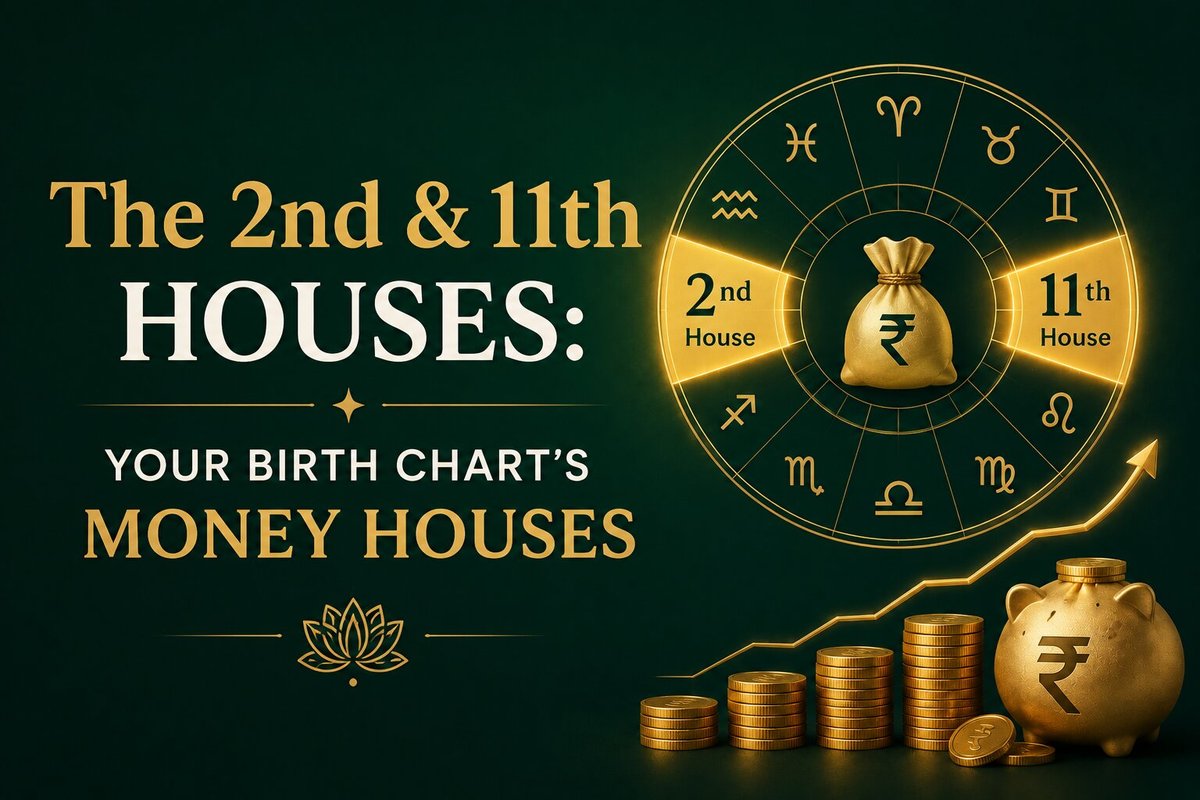
Two houses carry most of the financial weight in a Vedic chart, and they pull in opposite directions. The 2nd is dhana bhava, the house of accumulated wealth, and it holds. The 11th is labha bhava, the house of gains, and it delivers. Income enters through the 11th and settles in the 2nd, and a chart can be strong in one and empty in the other, which produces two entirely different financial lives.
The 2nd house: what you keep
Dhana bhava governs accumulation rather than income. Its classical significations are savings and stored wealth, jewellery and movable assets, family resources, the immediate family itself, food, speech, and the face.
That list looks scattered until you notice the common thread. Everything in it is something taken in and held: money, food, words before they are spoken. The 2nd is the house of retention, which is exactly why it governs savings rather than earnings.
Self-worth, the signification people skip
The classical texts link the 2nd to the value you place on yourself, and it is the most practically useful thing the house says. In behaviour this appears as what you are willing to charge, whether you negotiate, and whether you treat your own time as expensive.
A weak 2nd house with a strong 10th describes someone with a genuinely good career who prices below their level and cannot explain why. That pattern is common, it is expensive, and it is not a market problem.
Speech and money in the same house
Speech and wealth sharing a house is not a coincidence in the classical scheme. Both concern what you hold and what you release. The texts link an afflicted 2nd to harsh or careless speech and to money that does not stay, and treat them as the same underlying tendency expressed twice.
The 11th house: what actually lands
Labha bhava governs gains, and classical texts are unusually direct about its power. It is regarded as the strongest single house for income in the chart, and it governs elder siblings, networks and social circles, and the fulfilment of desires generally.
The rule that makes the 11th unusual
In most houses a malefic is a complication. In the 11th, classical texts read malefics favourably for gains. Saturn, Mars and Rahu in the 11th are all read as productive for income, which is not true of the 2nd or of most other houses.
The classical reasoning is that the 11th is an upachaya house, one of the growth houses along with the 3rd, 6th and 10th, where difficulty converts into capability over time. Malefics in upachaya houses are read as improving with age rather than obstructing.
If your 11th house holds Saturn or Rahu and someone has told you this is a problem, check the source. Classical practice reads both as favourable for gains in the 11th.
Gains through many, not through one
Because the 11th also governs networks and community, the classical picture of 11th-house income is plural: clients, customers, subscribers, a community. That is different from 10th-house income, which is what one profession pays. It is a useful distinction when deciding whether to deepen a career or widen an audience.
Read the lord, not the occupant
The single most common amateur error is reading only what sits in a house. With twelve houses and nine grahas, most houses are empty in most charts, and an empty house is not a weak one.
Each house is ruled by whichever graha owns the sign falling on it from your ascendant, and that lord carries the house's mandate wherever it sits. A well-placed 2nd lord with an empty 2nd house is classically stronger than a debilitated planet sitting inside it.
| Placement | Classical reading |
|---|---|
| 2nd lord in the 2nd | Own house. Steady accumulation, resources that stay. |
| 2nd lord in the 11th | One of the most quoted wealth combinations. What you keep is fed directly by what you gain. |
| 2nd lord in the 10th | Accumulation driven by profession. Salary and practice income building a base. |
| 2nd lord in the 6th, 8th or 12th | The classical caution. Savings exposed to debt, upheaval or outflow. |
| 11th lord in the 2nd | The mirror of the strong combination above, and read equally favourably. |
| 11th lord in the 11th | Own house. Gains that are reliable and network-driven. |
| 11th lord in the 12th | Gains arriving and leaving. Classically read as income consumed by expenditure. |
| 2nd and 11th lords in exchange | Parivartana, each in the other's sign. Classically the strongest form of connection between two houses. |
Planets in the two houses
| Planet | In the 2nd | In the 11th |
|---|---|---|
| Jupiter | Classically the most favoured. Wealth through knowledge, counsel and good judgement. See Jupiter in the 2nd. | Strong for gains, particularly through advisory work and large networks. See Jupiter in the 11th. |
| Venus | Pleasant speech, income through beauty, art or luxury. See Venus in the 2nd. | Gains through relationships, the arts and goodwill. |
| Mercury | Income through trade, calculation and communication. Often several streams. | Very well suited. Gains through commerce and many counterparties. |
| Saturn | Slow accumulation, delay, and a frugality that can tip into scarcity thinking. See Saturn in the 2nd. | Read favourably. Gains that build steadily and hold. See Saturn in the 11th. |
| Moon | Fluctuating resources, emotional attachment to savings, family involvement. See Moon in the 2nd. | Gains through the public and through popularity. |
| Sun | Income tied to status and to the father's line; spending that signals position. | Gains through institutions and senior people rather than through volume. |
| Mars | Classically difficult here. Assertive speech, and resources spent as fast as won. | Read favourably. Gains through competition, property and decisive action. |
| Rahu | Classically cautioned. Unconventional or unstable sources, and appetite outrunning the base. | Read strongly for gains, with the usual caution about their durability. See Rahu in the 11th. |
| Ketu | Detachment from accumulation. Classically the least acquisitive placement. | Gains arriving without being pursued, and held loosely. |
The counterweights: the 6th and 12th
No reading of the money houses is complete without them. The 6th governs debt, loans and litigation. The 12th governs expenditure and loss. Every rupee that leaves does so through the 12th, and a chart with strong wealth houses and a stronger 12th describes high income and no accumulation, which is one of the most common financial patterns there is.
The 8th sits alongside as the house of money arriving through others, covered in the 8th house, inheritance and sudden money, and the whole four-house picture is set out in which houses control money.
Dhana Yoga: when the two houses connect
A Dhana Yoga is precisely a connection between wealth-house lords, and the 2nd-11th link is its most direct form. The classical means of connection are conjunction, mutual aspect, exchange of signs, or one lord occupying the other's house.
Two conditions decide whether it means anything. The participating planets must be strong, which is what the D9 Navamsa tests. And the dasha of a participating planet must run during working life, or the combination is never switched on. See Raj Yoga vs Dhan Yoga for how this differs from the status combinations.
Timing
Houses describe structure. The Vimshottari dasha decides what is live. Classical expectation is that financial matters come forward during the period of the 2nd or 11th lord, or of a planet placed in either house. Print your own sequence on the Dasha Calculator.
Because all houses are counted from the ascendant, an inaccurate birth time undermines everything above. We measured how much: on one test chart a ten-minute error moved the ascendant a whole sign, put every planet in a different house and removed a yoga entirely. Full measurement in does birth time matter.
What our own research says
We backtest our indicators and publish the results either way. Across nine assets, two holding periods and forty-plus indicator and composite strategies, each corrected with a deflated Sharpe ratio, a fixed out-of-sample split and a probability-of-backtest-overfitting test, every asset returned indistinguishable from luck. Adding factors made the statistics worse, because each addition is another trial.
So we offer house analysis as a structured way of thinking about how money moves through a life, not as a forecasting tool. Method on the technology page.
Read your own two
On your free birth chart, note the signs on the 2nd and 11th, their lords, where those lords sit and in what dignity, and anything occupying either house. Then check whether the two lords connect. The financial birth chart report sets out the money-house detail, and the planets that influence wealth covers what each graha contributes.
Frequently asked questions
Which is more important, the 2nd house or the 11th?
Classical texts weight the 11th more heavily for income and the 2nd more heavily for what remains. In practice you need both: the 11th brings money in, the 2nd holds it. A strong 11th with a weak 2nd describes good income and poor retention, which is a very common pattern.
Is Saturn in the 11th house bad?
No. The 11th is an upachaya or growth house, and classical practice reads malefics there favourably for gains. Saturn in the 11th is traditionally read as income that builds slowly and holds, and improves with age. The same placement in the 2nd is read more cautiously.
What if my 2nd house is empty?
Normal and not negative. Most houses are empty in most charts. The 2nd is still ruled by the planet owning the sign on it, and that lord carries the accumulation mandate wherever it sits. A dignified 2nd lord with an empty 2nd house is stronger than an afflicted planet sitting in it.
What does the 2nd lord in the 11th house mean?
It is one of the most quoted wealth combinations in the classical literature: the lord of accumulated wealth placed in the house of gains, linking the two directly. It qualifies as a Dhana Yoga. Whether it delivers still depends on the planet's strength and on whether its dasha runs during working life.
Why do speech and money share a house?
Because the classical significations of the 2nd all concern taking in and holding: food, wealth, words. The texts read an afflicted 2nd as producing careless speech and money that does not stay, and treat the two as the same tendency showing up twice rather than as unrelated facts.
Can these houses tell me how much I will earn?
No, and the classical texts do not claim a number. They describe structure and character: whether income is plural or concentrated, whether it accumulates or passes through. Beyond the framework, our own backtests find no predictive power once corrected for multiple testing. We are not SEBI-registered and publish no financial recommendations.
Important disclaimer
Educational and awareness purposes only - not investment advice and not a recommendation to buy or sell any security or commodity. AstroCapitalX is not a SEBI-registered investment adviser. Markets carry risk; please consult a SEBI-registered adviser before investing.
Comments (0)
No comments yet - be the first.