Shani Retrograde 2026: Crude Oil, Gold and 7 Sectors to Watch
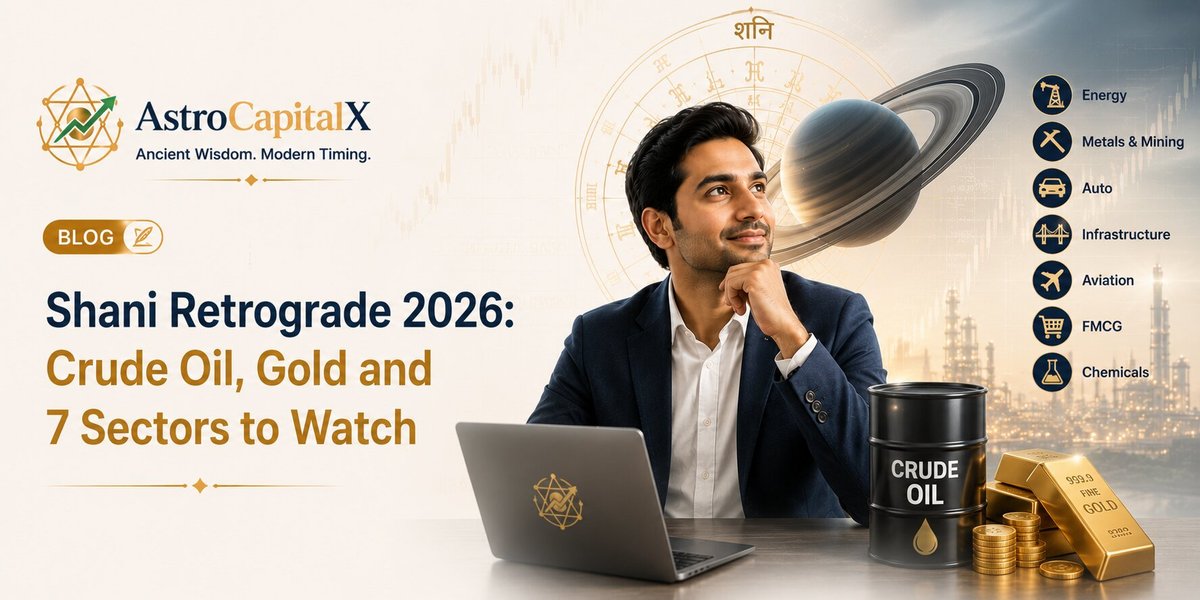
Shani, or Saturn, turned retrograde in late July 2026 and remains vakri until December. In Vedic financial astrology, Shani is associated with scarcity, discipline, heavy industry, mining, petroleum, labour and long economic cycles. Its retrograde phase is therefore watched closely, but it should be treated as a timing and sentiment lens, never as a stand-alone trading signal.
Commodity markets are shaped by physical realities: production, inventories, weather, transport routes, interest rates, currencies and geopolitics. Astrology does not replace those fundamentals. At its most responsible, financial astrology asks a narrower question: Are certain periods more likely to coincide with hesitation, reassessment or unusual volatility?
This guide explains how Vedic tradition interprets Shani’s 2026 retrograde motion, which commodities and sectors are symbolically connected with Saturn, and how investors can use the period to strengthen their decision-making process without turning planetary symbolism into a buy-or-sell command.
What does Shani retrograde mean?
A planet is called retrograde when it appears to move backward against the zodiac from Earth’s viewpoint. The planet does not physically reverse direction; vakri motion is an astronomical appearance created by the relative movement of Earth and the planet.
In Jyotish, retrograde motion is traditionally interpreted as an intensification or internalisation of a planet’s themes. Saturn governs structure, limits, accountability, delayed results and the consequences of earlier decisions. A Shani vakri period may therefore be read as a time when markets revisit assumptions about supply, regulation, debt, capacity and long-term value.
To see the exact transit dates and planetary positions used by the platform, consult the free Planetary Transit Calendar. Readers who are new to the subject can begin with the Financial Astrology Starter Guide.
Why crude oil, metals and mining receive attention
Traditional financial astrology connects Saturn with resources formed or extracted over long periods: coal, iron, minerals and substances found underground. Modern practitioners often extend that symbolism to crude oil, refineries, drilling equipment, pipelines, heavy machinery and capital-intensive infrastructure.
That association does not mean Saturn retrograde automatically pushes crude oil upward or downward. Direction depends on the complete planetary configuration and, more importantly, on actual market conditions. A supply disruption can lift crude regardless of an astrological bearish signal; a demand slowdown can weaken prices despite a symbolically favourable period.
The more defensible astrological expectation is not “oil will rise” or “oil will fall,” but that Saturn’s station and early retrograde phase may coincide with reassessment, delayed decisions and sharper reactions to supply news. Readers interested in the platform’s evidence standards should also read Retrograde Planets and Market Volatility: What the Data Actually Shows. Saturn’s longer cycles are covered separately in Sade Sati and the markets.
Seven sectors to watch during Shani vakri
| Oil exploration and production | Direct exposure to crude prices, reserve economics and drilling costs. | Production guidance, realised prices, sanctions and supply interruptions. | Refining and marketing | Profitability depends on refining margins, inventory valuation and fuel demand, not crude direction alone. | Crack spreads, product demand, inventory gains or losses and government pricing policy. | Airlines and aviation | Fuel is a major operating expense; sudden crude rallies can compress margins. | Jet-fuel prices, hedging, passenger yields and currency exposure. | Paints, chemicals and plastics | Many raw materials are derived from crude oil or natural gas. | Input-cost inflation, the ability to raise prices and demand conditions. | Tyres and automobiles | Synthetic rubber, transport costs and consumer fuel expenses create indirect exposure. | Rubber prices, vehicle demand, freight costs and the petrol to EV mix. | Metals, mining and cement | These Saturn-linked industries are energy-intensive and sensitive to infrastructure cycles. | Power and freight costs, construction demand, capacity utilisation and China’s industrial activity. | Logistics and shipping | Fuel expenses affect freight economics, while geopolitical risk can alter routes and insurance costs. | Diesel and bunker fuel, freight rates, route disruptions and port congestion. |
For a broader explanation of how planets are traditionally mapped to market groups, visit Nakshatras and Market Sectors and the dedicated Commodity Astrology guide.
What about gold and silver?
Gold is not primarily a Saturn commodity in classical symbolism. It is more commonly associated with the Sun and Jupiter, while silver is traditionally linked with the Moon. Yet both can react strongly during Saturn-dominated risk periods because investors often seek defensive assets when geopolitical uncertainty, inflation anxiety or financial stress rises.
That relationship is conditional. Higher real interest rates or a stronger US dollar can pressure precious metals, even when uncertainty is elevated. Gold should therefore be assessed through multiple lenses: central-bank demand, real yields, currency trends, physical demand and the full planetary picture.
Readers planning a culturally auspicious purchase can check the free Gold Muhurat Calculator. A muhurat identifies a traditional timing window; it does not indicate whether the market price is attractive.
Three practical scenarios for crude oil
1. Supply disruption: bullish pressure
If conflict, sanctions, storms or transport interruptions remove physical supply, crude prices can rise sharply. Under this scenario, upstream producers may receive support while airlines, paints, chemicals and logistics companies face higher costs.
2. De-escalation or excess supply: bearish pressure
If geopolitical tensions ease, production expands or global demand disappoints, the risk premium can unwind. Lower crude may help fuel-consuming sectors but weaken realisations for oil producers.
3. Conflicting signals: volatile consolidation
When supply risk is high but economic demand is soft, prices may swing without establishing a durable trend. This is the scenario most consistent with the cautious use of a retrograde framework: avoid treating the first breakout or reversal as confirmation.
How to use financial astrology responsibly
- Begin with fundamentals. Check inventories, production, demand, currency movements and geopolitical developments.
- Use astrology as a secondary timing lens. A transit can frame a research question; it cannot establish a trade by itself.
- Separate sector impact from price direction. Rising crude affects an oil producer and an airline very differently.
- Define risk before entering. Position size, diversification and a clear invalidation point matter more than conviction.
- Record the prediction in advance. Time-stamped forecasts reduce hindsight bias and make genuine evaluation possible.
AstroCapitalX explains its astronomical calculations and back-testing approach on the Technology page. You can also explore traditional timing windows through the free Commodity Muhurta tool, or read the wider stock market astrology guide.
The balanced conclusion
Shani retrograde 2026 is best understood as a period for review, discipline and closer examination of fragile assumptions. Crude oil, mining, metals, infrastructure and fuel-dependent industries fit Saturn’s traditional domain, but astrology alone cannot determine price direction.
The useful question is not “What will Saturn make the market do?” It is: “Where is the market structurally vulnerable, and am I prepared if the prevailing assumption is reversed?” That shift, from prediction to disciplined observation, is where financial astrology can become a thoughtful research lens rather than a source of certainty.
Frequently Asked Questions
Does Shani retrograde always make crude oil prices fall?
No. Vedic astrology does not support a reliable one-factor rule of that kind. Crude direction depends on physical supply, demand, inventories, currencies and geopolitics, along with the broader planetary configuration.
Which Indian sectors are most sensitive to crude prices?
Oil producers, refiners, airlines, paints, chemicals, plastics, tyres, automobiles and logistics businesses are among the most directly or indirectly exposed.
Can I trade using a commodity muhurta?
A muhurta is a traditional timing reference, not a trading recommendation or proof of favourable returns. Combine any astrological timing study with independent research and advice from a SEBI-registered professional.
How can I check the current planetary configuration?
Use the AstroCapitalX Transit Calendar, Today’s Panchang or Mercury AI for a current Vedic interpretation.
Comments (0)
No comments yet - be the first.